

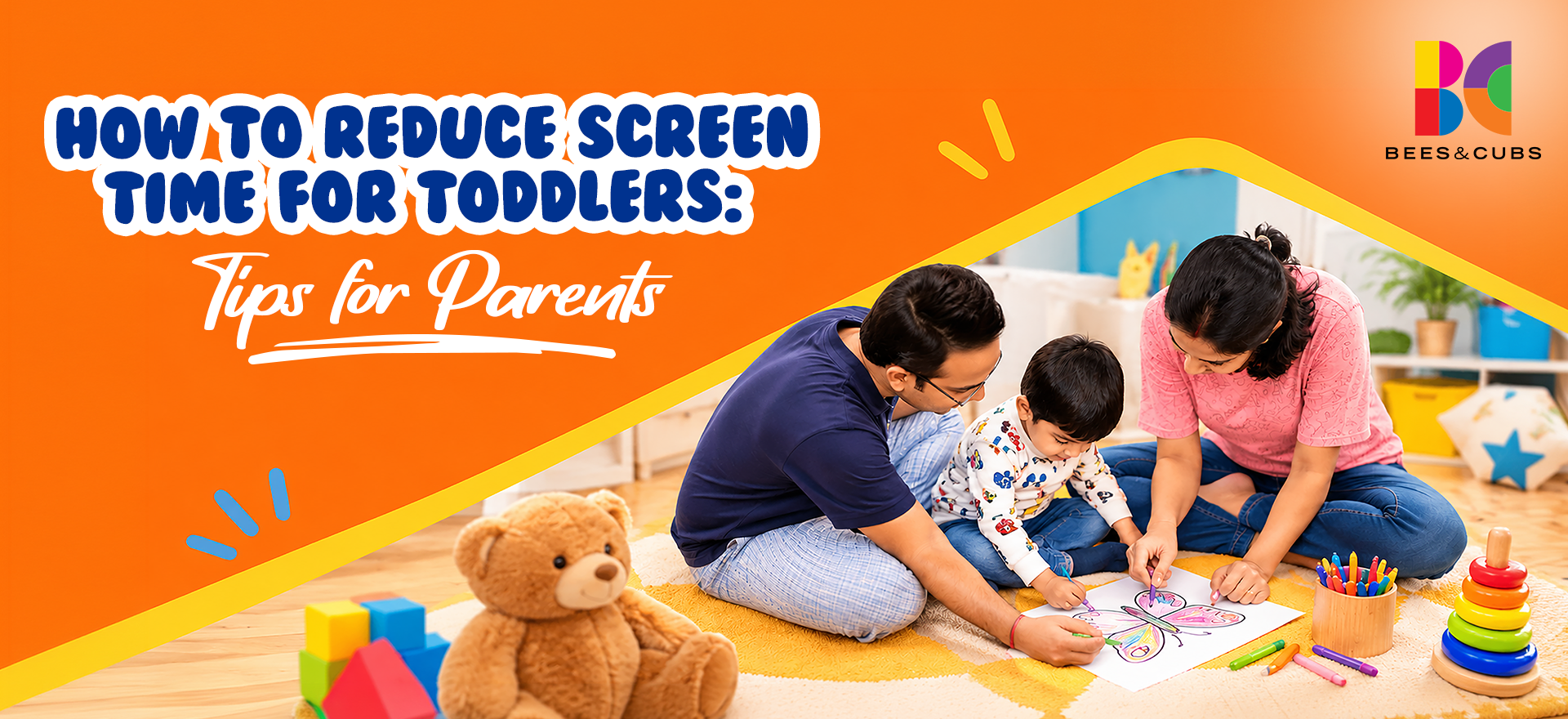
It usually starts with good intentions. A rhymes video to get through dinner. A cartoon so you can finish a work call. The phone handed over in an auto stuck in traffic. Then one morning you notice the tablet is the first thing your toddler asks for, and taking it away ends in tears, bargaining and a full meltdown on the floor.
If this sounds like your home, you are not doing anything unusual. Screens are built to hold attention, and a two or three year old has very little ability to switch off something that feels this rewarding. The answer is not to win a fight every evening. It is to set up your routine and your home so that fewer fights happen in the first place.
This guide walks you through how to do that, one practical step at a time.
Before cutting back, it helps to know what you are aiming for. The Indian Academy of Pediatrics (IAP) recommends that children below two years should not be exposed to any screens, and that children between two and five years should have no more than one hour of supervised screen time a day.
A video call with grandparents is different from passive watching, because your child is talking to a real person who responds. Many paediatricians treat it separately for that reason.
If your toddler currently watches three or four hours a day, do not panic and do not try to reach zero overnight. A gradual reduction you can sustain will do far more good than a strict rule that collapses by Thursday.
Understanding the struggle makes it easier to handle calmly.
Toddlers find transitions hard. Moving from anything they enjoy to anything else is difficult at this age, whether it is leaving the park or turning off a cartoon. Screens make this harder because the content rarely offers a natural stopping point. Autoplay rolls straight into the next video, and fast, bright, noisy shows keep a young brain alert and wanting more.
There is also the question of what comes next. If the screen goes off and nothing interesting replaces it, your child is left with a sudden gap, and protest is the most natural way to fill it.
So the tantrum is rarely about the screen alone. It is about an abrupt ending and an empty space afterwards. Fix those two things and most of the struggle eases.
Decide calmly, with your partner, when screens are allowed and when they are not. Rules made in the middle of a meltdown tend to be harsh one day and forgotten the next, and toddlers notice inconsistency very quickly. Simple, predictable rules work best, such as "no screens at meals" or "one show after the afternoon nap."
What a toddler cannot see, they ask for far less. Keep the tablet in a drawer instead of on the sofa. Do not leave the TV running in the background. Move video apps off your phone's home screen, and switch off autoplay on YouTube and streaming apps so every video has a clear end.
Not all screen time is equal. Shows with gentle pacing, real people and simple stories are easier to switch off than rapid-fire animated clips with constant music and flashing colours. Calmer content also leaves your child less wound up afterwards.
Give a warning before screen time ends: "Two more minutes, then we turn it off and go water the plants." A visual timer helps, because toddlers cannot read a clock but they can watch a timer run down. Let your child press the off button themselves. That small sense of control often prevents a protest.
Removing a screen without offering an alternative creates the empty gap described above. Keep a small activity basket ready with things your child can reach on their own: crayons and paper, blocks, a puzzle, play dough, a few picture books, and steel bowls and spoons from the kitchen. Rotate the items every week or so, so the basket feels new.
Better still, offer yourself. Ten minutes of your full attention, reading a story, building a tower or dancing to a song, is the most powerful replacement there is.
Most families have predictable moments when screens creep in: mealtimes, the hour before bed, car or auto rides, restaurant outings and a parent's work calls. Pick one danger zone at a time and plan a substitute.
When your toddler does watch something, sit with them when you can. Point to things, name them, ask simple questions and sing along. Shared viewing turns passive time into language practice, and it makes it far easier for you to end the session on your terms.
Toddlers copy what they see. If the adults in the house scroll through meals or keep phones in hand during play, children learn that screens are the normal thing to reach for. Try a few phone-free windows in your own day, such as meals and the first half hour after you get home from work.
In many Mumbai homes, grandparents, a nanny or a day care share the caregiving. If one adult says no and another hands over the phone, your child simply learns whom to ask. Have a short, friendly conversation with everyone involved and agree on the same few rules. Give grandparents and helpers a list of activities they can use instead, so they are not left without options.
Any change to a routine usually brings some pushback. Your toddler may protest more for the first few days while they test whether the new rule is real. This is normal, and it is a sign the change is landing. Stay calm, stay consistent and acknowledge the feeling without giving in: "You are sad the show is over. I know. Let's go find your blocks."
For many families, the protests ease noticeably within a week or two, though every child settles at their own pace.
Here is a simple example for a two to three year old. Adjust it to your family's timings.
The single short show is not a failure. It sits inside a full, busy day where the screen is one small part rather than the default.
A good early years setting naturally fills a child's day with the things screens push out: movement, conversation, hands-on exploration and play with other children. At Bees & Cubs, our Cambridge Early Years programme in Chandivali is built around play-based, experiential learning through art, music, movement and storytelling. Children who spend their mornings painting, singing, building and exploring often come home more interested in doing things than in watching them.
It also helps to talk to your child's teachers. Ask what your toddler enjoyed that day and try a version of it at home. A song from class or a craft they loved is an easy, ready-made replacement for screen time.
Reducing screen time is not about being perfect. Some days will include more screens than you planned, especially when someone is unwell or the week is overwhelming. That is fine. What matters is the overall pattern: clear rules, fewer temptations, smooth transitions and plenty of better things to do.
Start with one change this week. Hide the tablet, switch off autoplay or protect one mealtime. Once that feels normal, add the next.
If you would like to see how a play-based Cambridge Early Years day works in practice, book a school tour at Bees & Cubs, Chandivali, and see our classrooms in action.

