

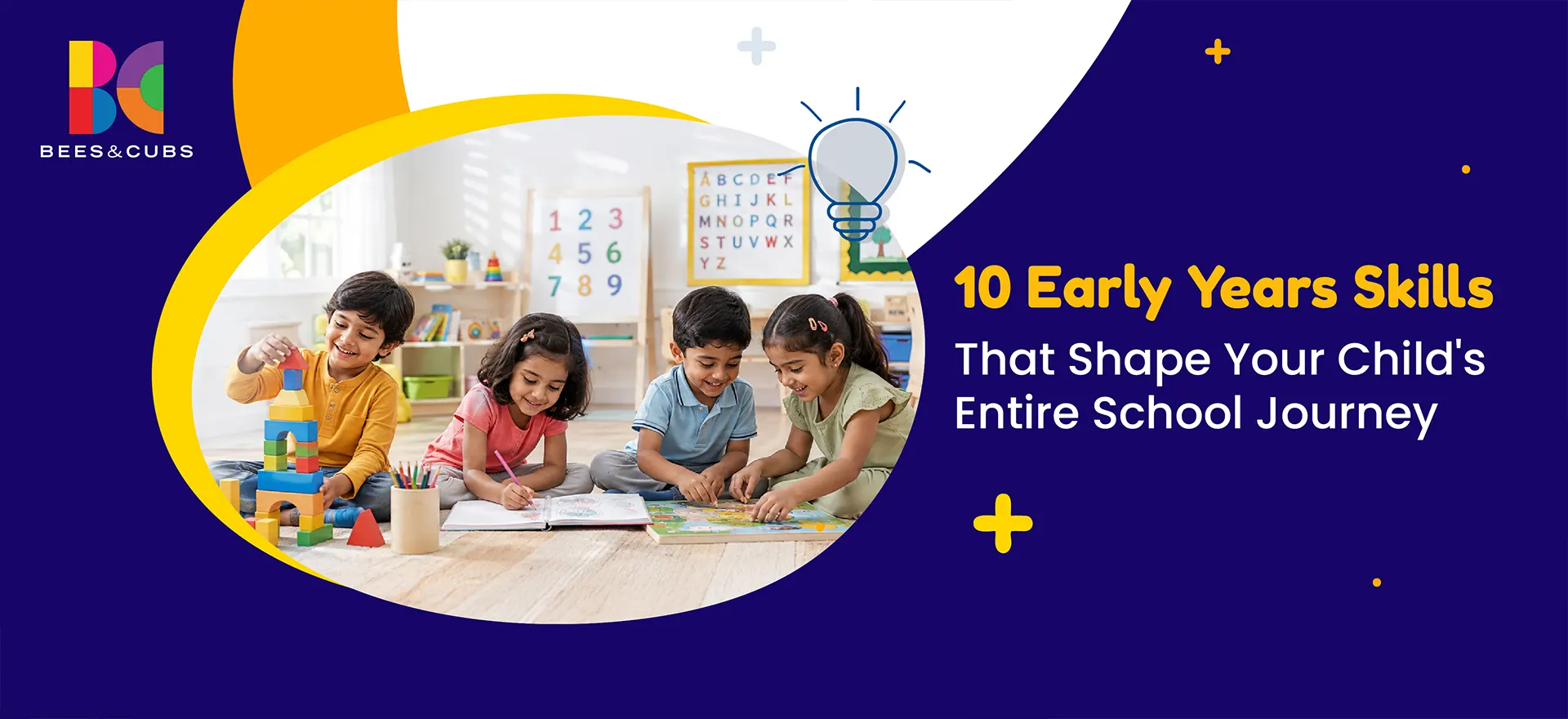
Most parents evaluate a preschool on what their child can show them at the end of the term. Can she write her name? Does he know his numbers up to twenty? Both are fair questions, but they measure the smallest part of what those years actually build.
The skills that carry a child through Grade 1, Grade 5 and the board exams that follow are quieter. They are the ability to sit with a difficult task for ten minutes instead of two. The ability to lose a game without falling apart. The ability to ask a question in front of twenty other children. None of these appear on a report card, and all of them decide how much benefit a child gets from every classroom they walk into afterwards.
Here are ten of them, and what they look like in a well-structured early years setting.
Self-regulation is the ability to manage impulses, wait, and recover from frustration. It is the single strongest predictor of how smoothly a child settles into formal schooling, because almost everything else in a classroom depends on it. A child who cannot wait for a turn cannot participate in group instruction. A child who cannot recover from a small failure will avoid anything hard.
Preschool builds this through repetition rather than instruction. Circle time asks a child to hold a thought until it is their turn to speak. A shared set of blocks asks them to negotiate rather than grab. Over two or three years, the gap between impulse and action widens, and that gap is where learning happens.
A caveat worth stating plainly: self-regulation develops on a wide timeline. A four-year-old who still melts down is not behind. Consistency at home and at school matters more than speed.
Vocabulary size at age five correlates strongly with reading comprehension years later, and comprehension is what eventually limits performance in science, social studies and mathematics word problems. Children who can only name objects struggle later with texts that describe processes and relationships.
Good early years teaching pushes past labelling. Instead of asking what colour the leaf is, a teacher asks why the child thinks it changed colour. Storytelling, songs, open-ended questions and daily conversation all expand the range of words a child hears and, more importantly, the range of sentence structures they can use.
For families in Mumbai raising children across two or three languages, this is worth knowing: bilingualism does not delay literacy in any lasting way. Early years children may mix languages for a period, then sort them out.
Early literacy is not the same as reading. Before a child decodes words, they need phonological awareness, which is the ability to hear that "cat" and "cap" differ at the end, and that "ball" and "bat" share a beginning. They need to understand that print carries meaning and moves left to right. They need to have handled enough books to expect a story to have a shape.
Children pushed into formal reading before these foundations are in place often decode accurately and understand very little. That is a hard problem to unpick in Grade 3. A structured Cambridge Early Years approach sequences the foundations first, then the letters, then the words.
Number sense means understanding what a number represents, not reciting the sequence. A child who counts to fifty but cannot tell you whether seven is more than four has learned a song, not mathematics.
Preschool builds number sense through physical materials. Counting steps to the garden, sorting buttons by size, dividing snacks equally, comparing two towers of blocks. These give the child a mental model of quantity that later abstract work can attach to. Children who skip this stage often cope until Grade 4 and then hit a wall when arithmetic becomes conceptual.
Handwriting fatigue in primary school is usually a motor problem, not a discipline problem. The small muscles in the hand develop through years of pinching, threading, tearing, moulding and gripping. Clay work, beading, tweezers, scissors, painting at an easel and buttoning a coat all do more for eventual handwriting than early tracing worksheets do.
Gross motor development matters just as much and gets less attention. Climbing, balancing, running and jumping build the core strength and postural control that let a child sit upright at a desk for a full period. Open outdoor space in a preschool is not a luxury feature. It is part of the curriculum.
Emotional literacy is the ability to name what you feel. A child who can say "I am frustrated because it keeps falling" does something very different from a child who can only cry or throw. Naming a feeling reduces its intensity and opens a path to solving the problem behind it.
This is taught directly. Teachers narrate emotions out loud, give children words for states they cannot yet describe, and treat feelings as information rather than misbehaviour. At Bees & Cubs, the Values We Instil framework builds this into daily language, pairing colours with qualities like kindness, calm, gratitude and enthusiasm so that abstract ideas become concrete for a four-year-old.
Carrying a bag, opening a tiffin, using the washroom, putting on shoes, cleaning up after an activity. These look like logistics. They are actually the child's first experience of being responsible for themselves, and they shape how a child sees their own capability.
Children who are dressed, fed and packed for by adults until age six often arrive in primary school anxious about small tasks, and that anxiety spreads into academic work. Daycare and full-day early years programmes give more practice at this than half-day formats do, simply because more of the day is spent doing it.
Curiosity is the one skill on this list that a school can easily destroy. Every child starts with it. Whether they still have it at age ten depends largely on whether their questions were treated as valuable or as interruptions.
Inquiry-based early years teaching keeps it alive by letting children investigate. What floats and what sinks. What happens to a plant kept in a dark cupboard. Why the shadow moves. The content is almost irrelevant. What the child is learning is that a question is worth following, that being wrong is part of the process, and that they are capable of finding out.
Attention span in early childhood is short by design, but it is trainable. A three-year-old might stay with an activity for five minutes. By six, with practice, that can stretch to twenty or more. The stretch comes from work that is genuinely absorbing and slightly harder than what the child can already do.
Persistence is the closely linked habit of staying with something after the first failure. It is built by adults who resist the urge to fix the tower, finish the puzzle or complete the drawing. A child who has spent three years being allowed to struggle safely arrives at school with a very different relationship to difficulty.
Ask what a normal day looks like rather than what the curriculum promises. Ask how much of it is outdoors, how much is child-led, how conflict between children is handled, and how many children each teacher is responsible for. Ask to see the space. A room designed for these ten skills looks different from a room designed for worksheets.
At Bees & Cubs, the Early Years Foundation section of Nahar International School in Chandivali, the Cambridge Early Years programme runs across Play Group for ages two and above, EY1 for ages three to four, EY2 for ages four to five and EY3 for ages five to six, with daycare available through the afternoon. The campus was built specifically for pre-primary, with open spaces, well-lit classrooms and a full-day structure that gives children time to practise all ten of these skills rather than rush through them.
If you are looking at preschools in Powai, Chandivali or Andheri East for the coming academic year, book a school tour and see the day in progress. That will tell you more than any brochure can.


6. Social competence
Social competence covers sharing, turn taking, joining a group, reading another child's face and repairing a friendship after a fight. Children learn this only by being in a group of peers, repeatedly, with adults nearby who guide rather than intervene at every conflict.
The value shows up later as the ability to work in teams, ask a teacher for help, and stay connected in a class of thirty. Children who arrive in Grade 1 without it often get labelled as difficult or shy, and both labels stick.